
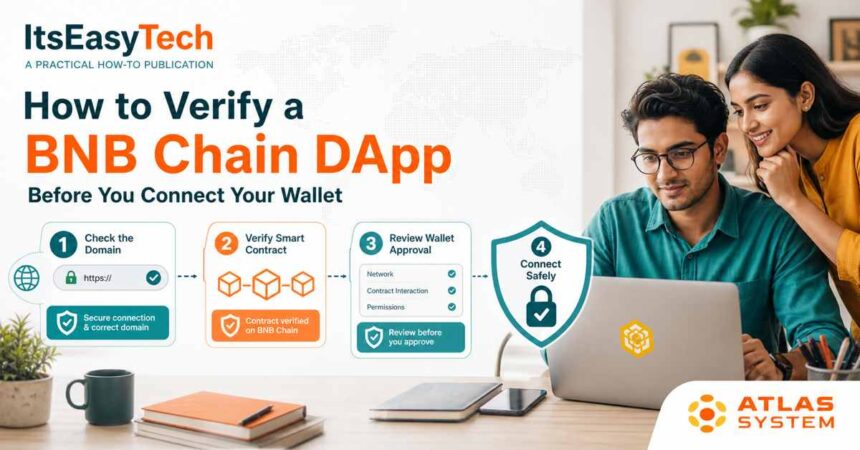
Decentralized applications make it possible to interact with financial protocols directly from a crypto wallet. That convenience also changes the user’s responsibility. There may be no bank representative, app-store review team, or payment processor available to reverse a transaction. Before connecting a wallet or signing a contract call, users need to verify what they are interacting with.
This guide explains a practical review process for BNB Chain dApps. It does not require programming knowledge, but it does require patience and attention to detail.
1. Start with the official domain
The first step is to identify the project’s real website. Search ads, copied social-media posts, and direct messages can lead to cloned interfaces. A fake page may look identical to the original while replacing the contract address or requesting a dangerous token approval.
Use links published through verified project channels and compare the domain carefully. Check spelling, the top-level domain, HTTPS, and any unexpected redirects. Bookmark the verified address instead of searching for it every time.
HTTPS protects data in transit, but it does not prove that the financial mechanism is safe. A fraudulent website can also use HTTPS. Treat it as one basic check, not a trust certificate.
2. Find the official contract registry
A professional dApp should make its contract addresses easy to locate. The addresses may appear in technical documentation, a transparency section, or a contract registry.
Copy the address from the official source and open it in BscScan. Do not rely on a shortened address shown in a screenshot. Compare the complete address character by character when the wallet asks you to approve a transaction.
If a project uses several contracts, identify the purpose of each one. There may be separate contracts for user deposits, claims, referral calculations, liquidity management, or governance. A list of addresses without an explanation is not enough.
3. Review contract activity
BscScan provides a public view of transactions, token transfers, contract methods, and balances. A non-technical user can still learn useful information from this data.
Look at how recently the contract has been used, whether transactions match the actions described by the platform, and which tokens move through the contract. Confirm that the network and token standard are correct. For example, USDT on BNB Chain should not be confused with a similarly named token on another network.
High activity does not prove safety, and a large balance does not guarantee that funds will be available for every future claim. The purpose of the review is to detect inconsistencies and understand the mechanism, not to obtain certainty from a single number.
4. Understand the source of any additional financial result
Whenever a dApp offers the possibility of receiving more than a user originally provided, ask where the additional amount comes from. Smart contracts automate transfers, but they do not create money.
Atlas System provides a useful example. Atlas describes itself as a digital mutual-financing platform operating through Smart Cycle on BNB Chain. A participant provides a Support Amount for a selected cycle. When the applicable conditions are met, the participant may request assistance that can include the original Support Amount and an additional Delta.
The Delta is the potential financial benefit of participation. It is the amount above the original Support Amount that may become claimable according to the selected cycle rules. This means Smart Cycle is designed to create an additional financial opportunity for participants; it is not simply a donation or charity mechanism.
The source and the risk must be understood together. Atlas explains that the additional Delta is formed through activity within the participant-funded mechanism. The return of the Support Amount and the Delta are not guaranteed and depend on the Smart Cycle conditions and available liquidity. Smart Cycle is not a bank deposit or a fixed-return investment product.
This is the type of explanation users should expect from any financial dApp. The project should state both what users may receive and what conditions could prevent that result.
5. Read the transaction before signing
Wallet confirmation screens often feel technical, but they contain important information. Check the connected domain, network, contract address, token, amount, and requested action.
Pay particular attention to token approvals. An approval allows a contract to spend a specified amount of a token from the wallet. Unlimited approvals can create unnecessary exposure if the contract or interface is compromised. Where possible, approve only the amount required for the intended transaction.
Never sign a transaction because a support agent, group administrator, or direct message creates urgency. Legitimate financial mechanics should remain understandable without pressure.
6. Separate technical audits from economic guarantees
An audit can identify certain vulnerabilities in contract code, access controls, and implementation. It does not guarantee that the business model will remain liquid or that every participant will receive the expected result.
Read the scope and date of an audit. Confirm that the reviewed address and contract version match the live system. Note unresolved findings and whether the report covers only code or also includes economic modeling.
For a mutual-financing mechanism such as Smart Cycle, both layers matter. Technical security concerns whether the contract behaves as designed. Economic risk concerns whether the participant-funded mechanism has enough activity and liquidity to process claims.
7. Inspect current liquidity and flows
Historical success is not proof of current capacity. Before participating, review the latest available information rather than relying on an old promotional post.
Useful indicators include current contract balances, recent incoming and outgoing transfers, the number of active wallets, claim activity, and any liquidity position disclosed by the platform. Compare these figures with on-chain records whenever possible.
If the potential Delta depends on participant activity, users should understand that falling inflows can affect future liquidity. This does not automatically mean the mechanism will fail, but it is a material risk that belongs in the decision.
8. Use a dedicated wallet for dApp interaction
Keeping long-term holdings and everyday dApp activity in the same wallet increases exposure. A safer practice is to use a separate wallet with only the amount needed for the interaction.
Protect the seed phrase offline, use hardware signing where appropriate, and never enter a seed phrase into a website. A legitimate dApp may ask a wallet to connect or sign a transaction, but it does not need the wallet’s recovery phrase.
After using a protocol, review active token approvals and revoke permissions that are no longer required.
9. Check the communication language
Financial promotions can reveal as much as technical documentation. Be cautious when a project uses phrases such as “guaranteed income,” “risk-free returns,” or “you cannot lose.” These statements are incompatible with the realities of smart contracts, liquidity, token prices, and participant-funded systems.
Accurate language should be conditional. In the Atlas example, a participant may receive an additional Delta under Smart Cycle rules, but that result is not promised. This wording is less dramatic, yet it gives users a more truthful basis for deciding whether the opportunity matches their risk tolerance.
10. Make a decision from evidence, not interface design
A modern dashboard can improve usability, but visual quality is not financial evidence. The strongest signals are consistent documentation, verifiable contract addresses, understandable money flows, current on-chain data, limited wallet permissions, and clear risk disclosures.
BNB Chain makes public verification possible, but it does not perform the verification for the user. The final responsibility remains with the person signing the transaction.
Before connecting to Atlas System or any other BNB Chain dApp, confirm the official domain, inspect the contracts, understand the source of the potential financial result, evaluate current liquidity, and accept that the outcome may differ from the displayed scenario. That process takes longer than clicking “Connect Wallet,” but it is one of the most valuable habits a Web3 user can develop.