
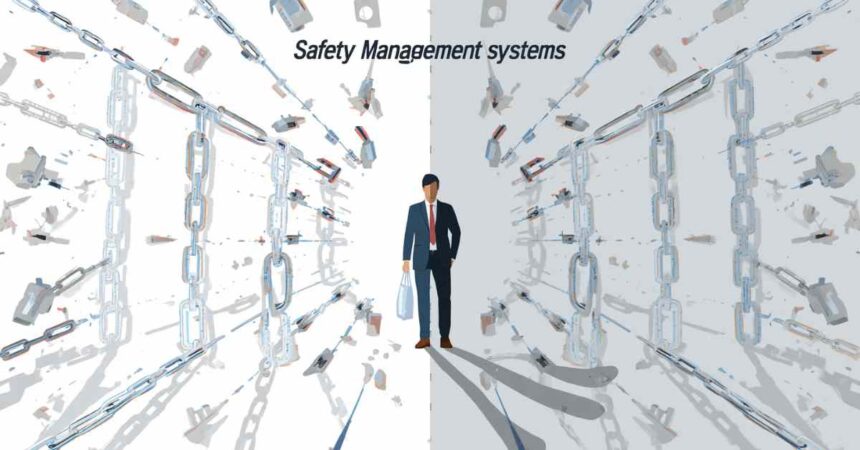
Most organizations have the policies, the training, and the records. What they often lack is a way to make those pieces work as one.
A safety program can look complete on paper and still leave gaps that stay hidden until something goes wrong. In 2024, private industry employers in the United States reported about 2.5 million nonfatal workplace injuries and illnesses, a reminder that safety outcomes depend less on any single policy or tool and more on how well the whole program holds together.
That is the idea behind safety management systems. OSHA describes an effective program through seven interrelated core elements: management leadership, worker participation, hazard identification and assessment, hazard prevention and control, education and training, program evaluation and improvement, and communication and coordination. The agency is clear that these work best as part of an integrated system, not a stack of separate activities.
The challenge for many organizations is not that these elements are missing. It is that they live in different places and do not function as one.
A documented program is not the same as a working system
Walk into most safety programs and the evidence of effort is easy to find. There are written policies, completed job hazard analyses, training certificates, incident reports, and audit checklists. On paper, the program looks complete.
The gap shows up in how those pieces relate to each other. Training records sit in one system, hazard assessments in a spreadsheet, incidents in a separate log, and corrective actions in email. Each part may be well maintained on its own, yet no single view shows how they connect. When that is the case, the organization has a documented program rather than a functioning system.
OSHA’s own guidance draws this line directly, noting that a safety and health program needs a systematic approach to finding and fixing hazards to be effective, not simply a written plan. A binder describes intent. A system produces outcomes.
Where the disconnect costs the most
When the parts of a safety program operate in isolation, the cost shows up at the moments that matter most.
A hazard identified during an inspection at one site does not inform the others running the same process. A corrective action is assigned after an incident and assumed to be closed. Training that was current last year no longer matches the roles people hold today. These are not failures of effort. They are what happens when information cannot move between the parts of the program.
Consider a common sequence. An incident points to a training gap, the gap is noted in the investigation report, and the actual training assignment is not made because the incident log and the learning system do not talk to each other. The intent was right and the finding was correct. The connection that would have turned it into action was missing.
The pressure becomes clearest during review. OSHA’s program evaluation and improvement element asks organizations to verify that the core elements are actually implemented and to track performance over time. That is difficult to demonstrate when the data needed to prove it is scattered across tools and files. When an auditor, a regulator, an insurer, or senior leadership asks to see the system working, the team ends up assembling a picture from fragments rather than showing one that already exists.
This is not a reflection of the safety team. It is a sign that the program was built as a set of documents and separate tools rather than as a connected system. Teams already doing this work well deserve infrastructure that lets the parts support each other.
What a connected safety management system looks like
Before looking at any specific platform, it helps to describe how the seven elements behave when they operate as one system, because that is what the software has to support.
Leadership sets goals and sees real progress on live dashboards rather than quarterly summaries. Workers report hazards and incidents from the field, and that information flows to the right people without manual handoffs. Hazards and risk assessments link to controls and to corrective actions that carry owners and due dates, and those actions are tracked until they are verified. Training and competency are tied to roles and kept current as those roles change. Incidents feed back into hazard identification, so the same event is less likely to repeat. Audits and program evaluation run on current data, and the loop drives continuous improvement.
The system, in other words, is the set of connections between the elements. The documents still matter, but the value comes from how the pieces inform one another in close to real time.
Where BIS fits
This is what BIS Safety Software was built to do. Rather than asking organizations to stitch together separate tools for training, hazards, incidents, and audits, BIS brings these functions onto one connected platform so the seven core elements can operate as a single system.
Training and competency, digital forms, hazard and risk assessments, incident management, inspections, and reporting share the same foundation. Workers and supervisors capture information from the field on a mobile device. Corrective actions are assigned with clear owners and due dates and tracked to completion, so accountability lives in the record. Role-based dashboards give leaders and site managers visibility across locations, records are retained and audit-ready, and continuous improvement is supported by reporting that reflects what is happening now rather than what was true at the last review.
The connection is the point. When training, hazards, incidents, and corrective actions live in one place, a finding in one area can drive action in another, which is what turns a documented program into a working system.
For safety teams ready to move from a documented program to one that operates as a connected whole, see how BIS Safety Management Systems bring training, hazards, incidents, audits, and corrective actions together on a single platform.
Frequently Asked Questions
What is a safety management system?
A safety management system is the connected framework an organization uses to manage workplace safety as one coordinated process rather than a set of separate activities. It links leadership, worker participation, hazard identification, controls, training, incident management, and program evaluation so the parts inform each other and improve over time.
What are the core elements of a safety management system?
In the United States, OSHA’s Recommended Practices describe seven interrelated core elements: management leadership, worker participation, hazard identification and assessment, hazard prevention and control, education and training, program evaluation and improvement, and communication and coordination. They are designed to work together as an integrated system rather than in isolation.
Is a safety management system required by OSHA?
OSHA’s Recommended Practices for Safety and Health Programs are voluntary guidance rather than a single federal mandate. The General Duty Clause does require employers to provide a workplace free from recognized hazards, and some states and specific standards, such as process safety management or state-level injury and illness prevention program rules, carry their own requirements. Confirm the obligations that apply to your industry and location.
What is the difference between a safety management system and a safety manual?
A safety manual is documentation. It records policies, procedures, and intent. A safety management system is how those policies operate day to day, connecting hazards, training, incidents, and corrective actions so the program produces results and can be verified. A manual describes the program; the system runs it.
How does BIS support a safety management system?
BIS brings training and competency, digital forms, hazard and risk management, incident management, inspections, and reporting onto one connected platform. That lets the core elements of a safety management system operate together, with field data capture, corrective action tracking, role-based dashboards, and audit-ready records supporting continuous improvement across sites.