
For over twenty years, searching the internet meant one thing: typing a few keywords into Google and scrolling through a list of blue links. That experience is changing fast. Artificial Intelligence (AI) has transformed how we find information, shifting from a list of websites to direct, conversational answers.
But with so many new tools available, it can be hard to know which one to trust. You might be used to Google, but newer competitors like ChatGPT Search and Perplexity are claiming they can do it better.
In this post, we will compare these three major players to help you decide which tool gives the best results for your specific needs.
Meet the Contenders
Before we look at how they perform, let’s quickly define what each tool actually is.
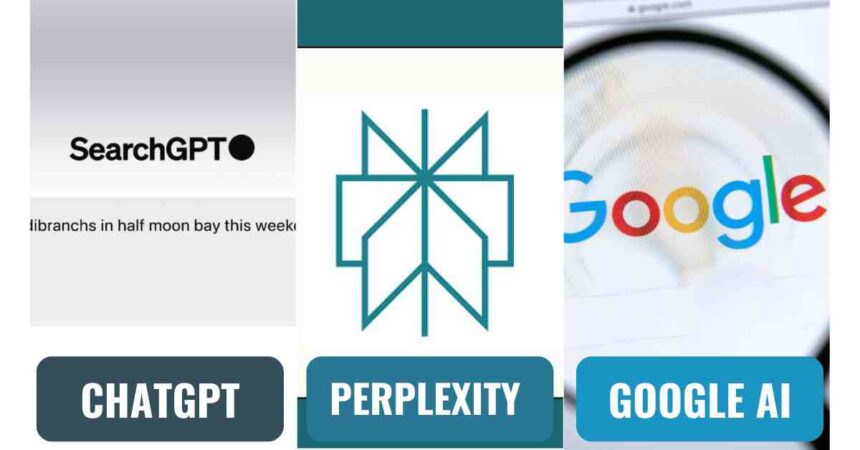
1. ChatGPT Search
This is a feature built into OpenAI’s popular chatbot. It allows ChatGPT to access real-time information from the web.
Instead of relying only on its training data (which cuts off at a certain date), it browses the internet to answer your questions with current facts.
2. Perplexity
Perplexity calls itself an “answer engine.” It is designed specifically for search.
Unlike a standard chatbot, its primary goal is to read multiple websites and synthesize that information into a clear, cited answer.
3. Google AI Overviews
This is Google’s response to the AI competition. When you search on Google, you might now see a shaded box at the very top of the results page.
This “overview” uses AI to summarize the answer to your query before showing you the traditional list of websites.
Comparing Accuracy, Sources, and Experience
When you need an answer, you usually care about three things: is it right, can I trust it, and is it easy to use?
Accuracy and Trust
Perplexity shines here. Because it was built as a research tool first, it is very good at staying on topic. It usually provides the most direct answer without “hallucinating” (making things up) as often as general chatbots.
ChatGPT Search is also strong, especially with its upgraded models. However, because it is conversational, it can sometimes prioritize sounding human over being purely factual.
Google AI Overviews has had a rocky start. While often helpful for simple facts, users have reported strange errors in its summaries. However, Google has a massive advantage in local data, like store hours and maps.
Citing Sources
If you are doing research for work or school, you need to know where the information comes from.
- Perplexity: This is the clear winner for citations. Every claim usually has a small number next to it that links directly to the source.
- ChatGPT Search: It now includes prominent links to sources, often in a sidebar or inline, making it much better than it used to be.
- Google AI Overviews: It lists source links below the summary, but they can sometimes feel cluttered or hard to distinguish from ads.
User Experience
ChatGPT feels the most like talking to a smart friend. You can ask follow-up questions easily. Perplexity feels like a professional research assistant. Google feels like… Google. It is familiar, but the AI box can sometimes push the actual website results too far down the page.
To understand more about how these models process information, you can read about Large Language Models here.
Which Tool Should You Use?
Different tools work better for different tasks. Here is a quick breakdown of use cases to help you choose.
Best for Deep Research: Perplexity
If you need to write a report, plan a complex travel itinerary, or understand a medical topic, Perplexity is often the best choice. It reads multiple sources and combines them into a cohesive answer with clear footnotes.
Best for Creative Projects and Coding: ChatGPT
If your search is part of a creative workflow—like writing code or drafting an email—ChatGPT wins. You can search for the latest documentation on a coding library and then immediately ask ChatGPT to write the code for you in the same window.
Best for Quick Facts and Shopping: Google
If you want to know “when does the hardware store close?” or “best running shoes under $100,” Google is still king. Its integration with Google Maps and Google Shopping makes it superior for local and commercial searches.
For a deeper dive into how search engines are evolving, check out this article from Search Engine Journal.
The Verdict
The “best” search tool depends entirely on what you are looking for.
If you want a traditional search experience that simply summarizes the links for you, Google AI Overviews is convenient because you don’t have to switch apps.
If you want to have a conversation and iterate on your ideas with live data, ChatGPT Search is powerful and fluid.
However, if your goal is pure information gathering with reliable sources, Perplexity is currently the strongest option for accuracy and transparency.
The best approach? Don’t limit yourself to just one. Keep Google for your shopping and maps, but try Perplexity or ChatGPT the next time you have a complex question that needs a real answer, not just a list of links.