

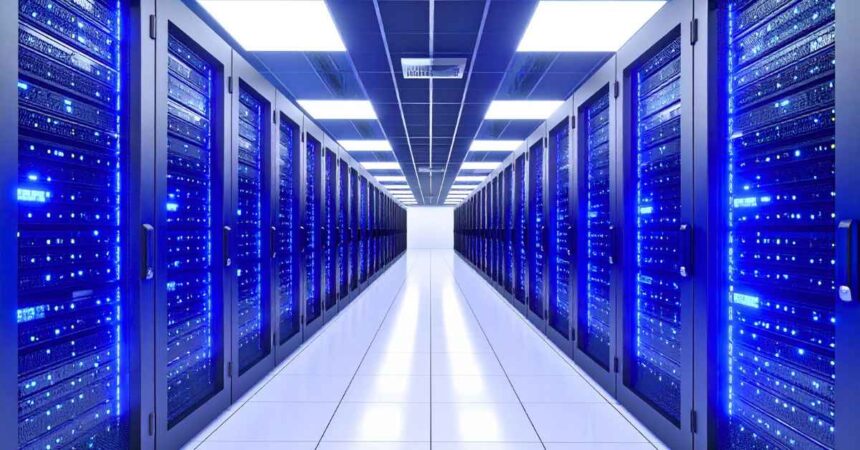
A data centre is more than a space for servers and other IT equipment. Its power, cooling, physical layout, connectivity, and supporting systems all need to work together to keep workloads running reliably. As computing requirements change, a decision made in one area can create limitations somewhere else.
For teams who want to learn how data centre design supports infrastructure planning, this relationship is an important starting point. Planning cannot focus only on the capacity a facility needs today. Let’s explore the key factors that shape a data centre designed to support both present needs and future growth.
How to Design a Data Center?
Physical infrastructure determines how reliably IT equipment receives power, removes heat, and operates within available space. Power, cooling, racks, and monitoring should therefore be planned as connected systems rather than separate installations. Let’s look at the main areas teams should address during data center design.
1. Size Power Around IT Load and PUE
IT load provides the starting point for estimating facility power requirements. Teams must then account for electricity used by cooling, power conversion, lighting, and supporting equipment.
Power Usage Effectiveness (PUE) compares total facility energy with the energy consumed by IT equipment. Using IT load and PUE together can support more informed sizing of utility supply, UPS systems, and electrical distribution.
2. Match Cooling to Rack Density
Servers and computing equipment convert electrical energy into heat during operation. As more processing capacity is concentrated within each rack, heat density rises and cooling requirements change.
Air cooling can support many conventional environments, while high-density computing may require liquid cooling or combined air-and-liquid approaches. Early density planning helps data center design account for cooling requirements before additional racks create thermal constraints.
3. Define the Required Power Resilience
Uninterruptible power supply systems support critical IT loads during power disturbances and short interruptions. Their configuration depends on availability requirements, backup duration, redundancy, and the electrical distribution architecture.
Teams should define these requirements before selecting equipment. This helps balance operational resilience with infrastructure cost instead of adding unnecessary redundancy.
4. Coordinate Racks, Airflow, and Power Distribution
Rack layout influences more than equipment placement. It affects airflow paths, cable routing, maintenance access, rack power distribution, and the position of cooling equipment.
Planning racks alongside containment, rack PDUs, and cooling paths helps prevent physical layouts from limiting future equipment deployment. This coordination makes data center design easier to adapt as rack configurations change.
5. Include Monitoring From Day One
Data center infrastructure management, or DCIM, provides visibility across assets, power, environmental conditions, and available capacity. It can combine monitoring, measurement, modeling, and infrastructure management within one environment.
Including DCIM during planning gives operators useful information from the start. Teams can track capacity and operating conditions instead of adding visibility only after problems emerge.
Validate Data Center Design Before Deployment
A design should be checked against expected IT load, rack density, power demand, cooling
requirements, and planned growth before equipment is installed. This helps teams identify
infrastructure constraints early and make adjustments while changes are still easier to manage.
Let’s look at the key checks that can strengthen data center design before deployment.
- Verify IT Load and Power Requirements
- Check Cooling Against Rack Density
- Review Redundancy and Availability Needs
- Compare Layout With Reference Designs
- Confirm Space for Phased Expansion
Plan for the Next Capacity Decision
A useful infrastructure plan should show teams when expansion or modernization needs attention. Capacity thresholds for rack space, power, cooling, and equipment utilization can provide clear points for technical review.
Data center design should be treated as an ongoing process supported by operating data rather than a one-time construction exercise. Partnering with reputable electrical firms can help organizations coordinate power, cooling, monitoring, and modernization requirements as IT demand changes. This gives teams a stronger basis for making the next infrastructure investment at the right stage.