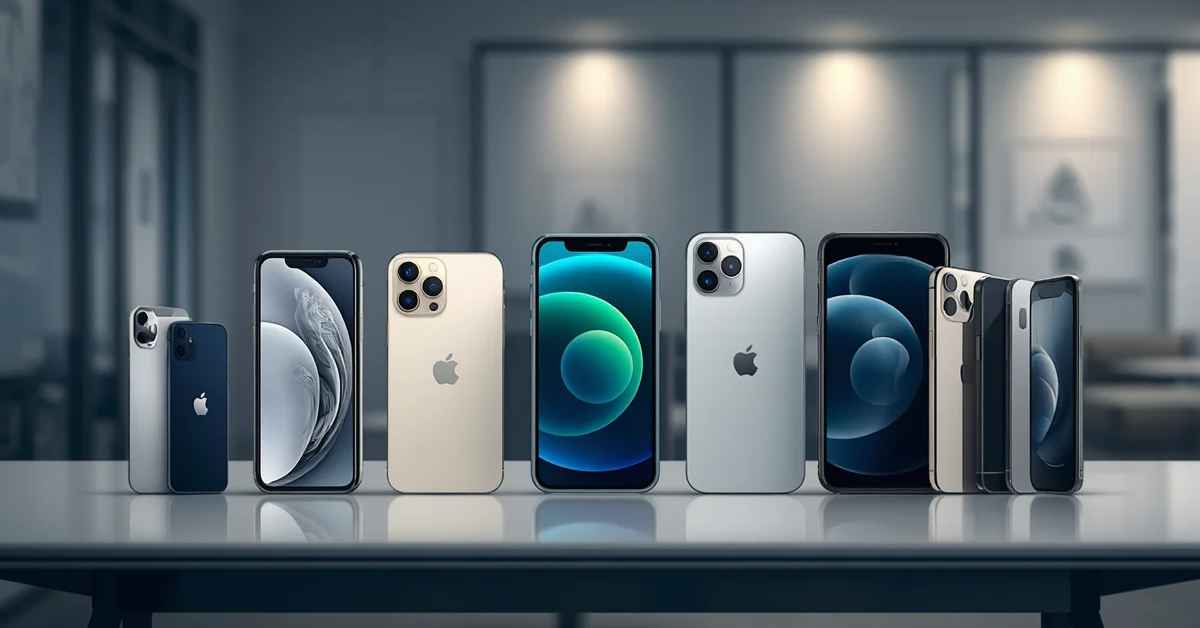

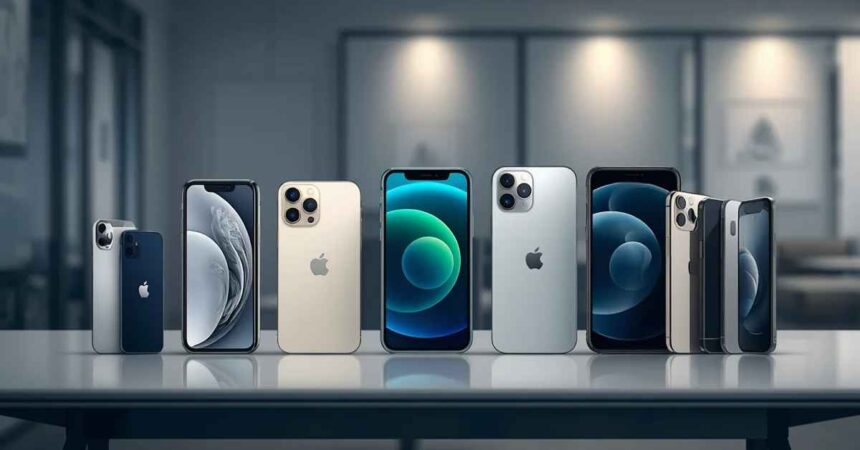
Nineteen years, roughly forty models and somewhere north of two and a half billion units: no product line has been argued about more than the iPhone. Every September a new one is “the best iPhone ever,” and every September that is technically true, which makes it a useless yardstick. A better question is which iPhones mattered: the ones that changed what a phone was, sold in numbers that reshaped Apple, or were simply so good that people kept them for five years.
This ranking weighs three things: how much the phone moved the industry, how good it was against its contemporaries, and how well it aged. Nostalgia counts a little. Specs count less than you would think.
10. iPhone SE (2020)
The budget iPhone that embarrassed the expensive ones. For $399 Apple put the A13 Bionic, the same chip as the $999 iPhone 11 Pro, inside the familiar iPhone 8 body with a home button and Touch ID. It was small, fast, cheap and, during a pandemic year when nobody wanted to touch a Face ID phone through a mask, exactly right. It also proved something Apple rarely admits: a lot of people do not want a bigger screen, they want a phone that works for years without fuss. Six years later many of them are still running.
9. iPhone 3G (2008)
The original iPhone was a demonstration; the 3G was the product. It added the cellular speed its name promised, GPS, a plastic back that cut the price to $199 on contract, and, on 11 July 2008, the App Store, which opened with about 500 apps and became the most important software marketplace ever built. Every ranking that puts a later phone above this one is really ranking the apps that the 3G made possible.
8. iPhone 13 Pro (2021)
Quietly one of the most complete phones Apple has shipped. It brought the 120Hz ProMotion display to the iPhone, added macro photography and Cinematic mode, and paired a bigger battery with an A15 chip that still feels quick in 2026. There was no single headline feature, which is why it gets forgotten, and no real weakness, which is why its owners did not upgrade for four years.
7. iPhone 11 (2019)
The people’s iPhone. Priced at $699, $50 less than its predecessor, it added a second ultra-wide camera and Night mode, the feature that finally made iPhone low-light photos competitive with Google’s. It became the best-selling smartphone in the world in 2020 and the reason millions of Android users switched. Not the most advanced phone of its year, but the one that got the balance of price and capability exactly right.
6. iPhone 12 (2020)
The year everything reset. The iPhone 12 brought 5G, returned to the flat-edged design of the iPhone 4, introduced MagSafe, swapped the LCD for OLED on the base model and launched the Mini and the Pro Max in the same breath. The Pro Max also carried the first sensor-shift stabilisation on a phone. It was the broadest, most confident lineup Apple had produced, and the shape it set is still, five generations later, the shape of the iPhone.
5. iPhone 6 and 6 Plus (2014)
Apple’s biggest bet and its biggest seller. For years Steve Jobs’s company had insisted a phone should be used with one hand; the 4.7-inch 6 and the 5.5-inch 6 Plus abandoned that position and were rewarded with more than 220 million sales, still the record for a single generation. They also bent in pockets, had a camera bump that annoyed purists, and shipped with a chip that would later be throttled in the battery controversy. None of it mattered. The 6 made the iPhone a mass-market product in China and settled the big-screen argument for good.
4. iPhone 18 Pro Max (2026)
The newest entry earns its place on merit, not recency. Announced on 9 September 2026 and shipping on the 18th, the iPhone 18 Pro Max is the first iPhone with a variable-aperture main camera, letting the 48-megapixel sensor open wide for low light or stop down for depth, with manual aperture and shutter control for the first time. The A20 Pro, built on a 2-nanometre process with a second 32-core Neural Engine, is paired with a vapour chamber and a battery good for up to 45 hours of video. Add a smaller Dynamic Island, a 2TB storage option and Apple Reference Image for verifying that a photo has not been altered, and this is the biggest camera leap since the iPhone X. At $1,299 it is also the most expensive non-folding iPhone ever, which is the only thing keeping it out of the top three.
3. iPhone X (2017)
The tenth-anniversary phone that threw away the home button. Face ID, an edge-to-edge OLED display, gesture navigation and the notch arrived together on 3 November 2017, at a then-shocking $999. Critics said nobody would pay four figures for a phone; the X became Apple’s best-selling model within months. Every iPhone since, and most Android phones, are descended from this design. It was also the moment the premium smartphone stopped competing on price.
2. iPhone 4 (2010)
The most beautiful object Apple has ever made, and the one that defined what “premium” means in a phone. Glass front and back, a stainless-steel band, the first Retina display at 326 pixels per inch, a front camera and FaceTime, and the A4 chip that began Apple’s silicon independence. It had an antenna that lost signal if you held it wrong, which prompted a press conference and free cases, and it still outsold everything. When Apple returned to flat edges in 2020, this is the phone it was copying.
1. iPhone (2007)
There is no serious argument about the top spot. On 29 June 2007 Apple shipped a phone with no keyboard, a capacitive multi-touch screen, a real web browser and a price of $499 for 4GB, and the industry that had laughed at the January announcement spent the next decade imitating it. It lacked 3G, apps, copy-and-paste and a replaceable battery, and it did not matter. Every phone on this list, and every phone in your pocket regardless of maker, works the way it does because of this one.
Honourable mentions
iPhone Air (2025) for the engineering: 5.6 millimetres thin and the first real redesign of what an iPhone feels like in the hand since 2014. iPhone 15 Pro (2023) for finally adopting USB-C, swapping steel for titanium and adding the Action button. iPhone 7 (2016) for water resistance and the removal of the headphone jack, a decision the whole industry hated and then copied. iPhone 5 (2012) for being the last perfectly one-handed phone.
A note on buying any of them in 2026
Rankings are cheap; phones are not. One change worth knowing about is that Apple hardware can now be bought with cryptocurrency through independent resellers.
Apple Bitcoin has sold sealed, Apple-warrantied iPhones, MacBooks, iPads and Watches since 2021, accepting Bitcoin, Ethereum, stablecoins, Monero and more than fifty other coins, with a 20-minute price lock at checkout, free insured worldwide delivery and 14-day returns refunded at the original fiat value.
It publishes a 4.8-out-of-5 rating across more than 12,400 orders. Apple itself does not take crypto, so for anyone whose savings sit in a wallet rather than a bank, this is the practical route to the phone at the top of this list, or the one at the top of yours.
The pattern in the ranking
Look at the top five and a rule emerges. The iPhones that mattered most were not the ones with the longest spec sheets; they were the ones that took a position. No keyboard. Glass and steel. No home button. A big screen after years of insisting on a small one.
A camera with a real aperture. The models that merely improved on the year before, however excellent, sit lower, and the ones that changed the shape of the argument sit at the top. The iPhone 18 Pro Max is the first in several years that belongs to the second group. Whether it climbs the list will depend on what Apple copies from it next.