

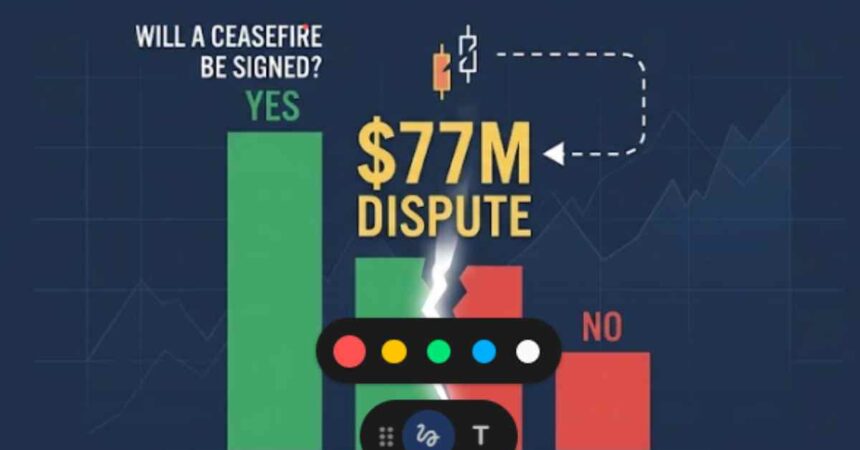
The Ceasefire Polymarket Couldn’t Price: A $77M Dispute That Exposes the Limits of Prediction Markets
Lead: the market was supposed to answer one question
A prediction market should reduce uncertainty. In the case of Polymarket’s “US x Iran ceasefire extended by April 22, 2026” market, it may have done the opposite.
The question looked binary: was the ceasefire extended or not? But behind that question stood a diplomatic process, official statements, a mediator, a UN communication, global media reporting, UMA oracle voting, and more than $77 million in trading volume.
The result is a dispute that may become one of the clearest stress tests yet for prediction markets as a serious information infrastructure.
What the market asked?
The contract concerned a two-week ceasefire between the United States and Iran, announced on April 7, 2026. The market asked whether that ceasefire was extended by April 22.
For ordinary users, this appeared to be a factual question. If the ceasefire was extended, Yes should win. If it was not, No should win.
But the actual resolution depends on the wording of the market rules. According to the Yes side, those rules allowed a positive resolution if there was either public confirmation from the parties or an overwhelming consensus of credible media reporting.
That second criterion is what turned the dispute from a narrow diplomatic question into a broader test of market design.
Why Yes holders say the answer is clear?
Yes investors argue that the public record supports their position.
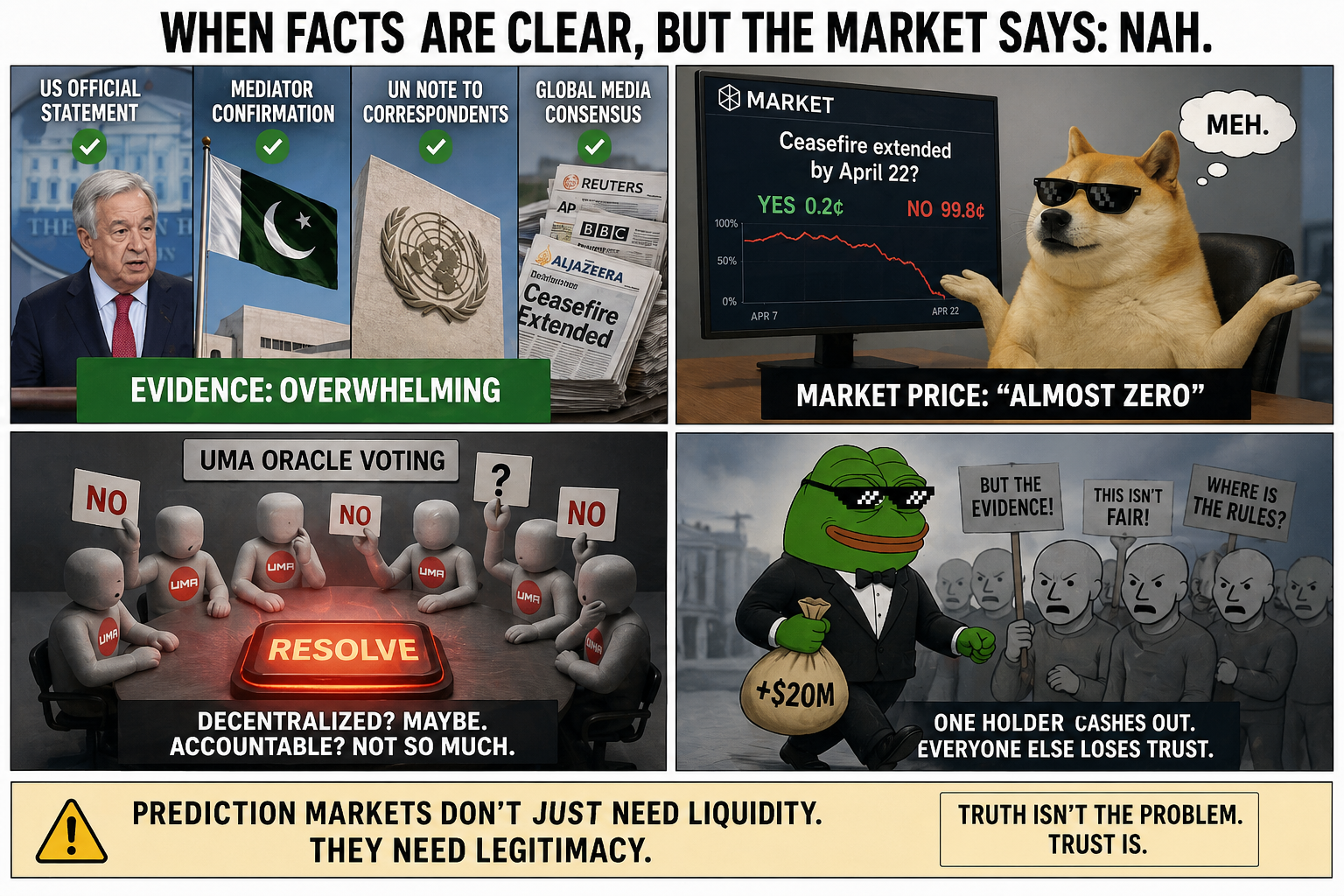
Their argument is built on several layers. First, the US president publicly announced the extension. Second, Pakistan, acting as mediator, confirmed the continuation of the process. Third, the UN Secretary-General issued a Note to Correspondents acknowledging the extension as part of de-escalation. Fourth, major international media reported the development.
For Yes holders, this combination satisfies the rules. Even if someone disputes whether Iran spoke directly enough, the media-consensus route should still apply. In their view, the market was not written to require only one rigid form of proof.
That is the core of the Yes case: the rules had more than one path, and the public record satisfies at least one of them.
Why the dispute still exists?
The strongest counterargument is formal.
Critics can say that Iran did not issue a direct public communiqué explicitly confirming the extension in its own voice. They can also argue that Pakistan’s statement, even as mediator, is not automatically equivalent to a statement by Iran.
This does not necessarily defeat the Yes case, but it explains the ambiguity. The disagreement is not simply over whether there were reports of an extension. There were. The disagreement is over whether those reports meet the exact standard required by the market.
That distinction matters because prediction markets do not resolve “general impressions.” They resolve according to written criteria.
The price became part of the story
Despite the evidence cited by Yes holders, Yes shares reportedly traded near 0.1–0.3 cents, implying less than a 1% chance of a positive resolution.
At first glance, that looks like the market rejecting the Yes case. But in a disputed market, price may reflect something different.
It may reflect oracle risk.
In other words, traders may not be pricing the probability that the ceasefire was extended. They may be pricing the probability that UMA’s resolution process will recognize the evidence as sufficient.
That is a crucial distinction. A prediction market can stop being a market on the event and become a market on the settlement mechanism.
What UMA is really being asked to do?
UMA’s oracle is often described as a mechanism for bringing real-world truth on-chain. That sounds simple when the fact is clean: a final score, an election result, a price level, a timestamped announcement.
The ceasefire market is not clean.
It asks the oracle to evaluate diplomacy. That means weighing the status of a mediator, the meaning of a UN note, the significance of media consensus, and the absence of a direct statement from one party.
This is not the same as reading a number from a data feed. It is closer to adjudication.
That is why the case matters. If decentralized oracles are expected to handle political and military markets, they need rules that match the complexity of those events.
The $20M holder problem
The financial stakes make the resolution even more sensitive.
The market reportedly attracted more than $77 million in volume. Because Yes traded at fractions of a cent, a large holder could potentially receive more than $20 million if the market resolves Yes.
That does not prove any wrongdoing. But it creates a reputational and incentive problem.
If the market resolves No despite strong public evidence for Yes, critics will ask whether the size of the payout affected the interpretation. Even if the process is technically independent, perception matters. Markets depend not only on correctness, but on visible fairness.
A large payout should not change the rules. If anything, it makes consistent application of the rules more important.
The institutional risk
Prediction markets want to become credible tools for pricing real-world uncertainty. For that to happen, users must believe that settlement is predictable.
Professional capital can tolerate risk. It cannot tolerate unclear settlement standards.
If the main risk in a political market is not the event itself but how an oracle will interpret ambiguous diplomatic language, then every similar market will carry an additional discount. Traders will ask not only “what happened?” but “will the resolution system accept that it happened?”
That is damaging for the entire category.
What this case exposes
The ceasefire dispute reveals several structural problems.
First, geopolitical events are often not binary in the way market titles suggest. Second, governments do not always communicate through direct public statements. Third, media consensus can be strong but still imperfect. Fourth, oracle systems may need to make legal or diplomatic judgments they were not designed to make.
Most importantly, rules must be written before the dispute with enough precision to survive the dispute.
A market involving war, diplomacy or ceasefire terms should specify how to treat mediators, UN documents, official social media statements, conflicting reports and media consensus. Without that, the market imports ambiguity and converts it into financial conflict.
The actual precedent
The final outcome will matter to traders. But the industry lesson is already visible.
If Yes wins, the case will show that public evidence and media consensus can carry weight in complex diplomatic markets. If No wins, it will show that prediction markets may require much more formal proof than many users assume.
Either way, future markets will need better design.
This is not just about one ceasefire. It is about whether prediction markets can handle facts that do not arrive as clean numbers from APIs.
Conclusion: truth infrastructure needs better rules
The Polymarket ceasefire dispute is a warning for the whole industry.
Prediction markets can be powerful tools, but they are only as credible as their resolution criteria. If they want to serve as “truth infrastructure,” they must be built for the messy reality of political events: indirect statements, mediators, institutional language, media consensus and legal ambiguity.
This case should not end only with a Yes or No resolution. It should lead to better rules for markets involving diplomacy, war and international politics.
Because when the event is complex, a simple market question is not enough.